
What happens after Shazam identifies a song?
Shazam is used to quickly identify songs, but the experience starts and ends there.
We asked ourselves: What can we do that is truly valuable to extend the user’s experience?
📅 2.5 weeks 👥 Izaac Seymour, Vivian San, Vernesha Jones, Tamara Grant
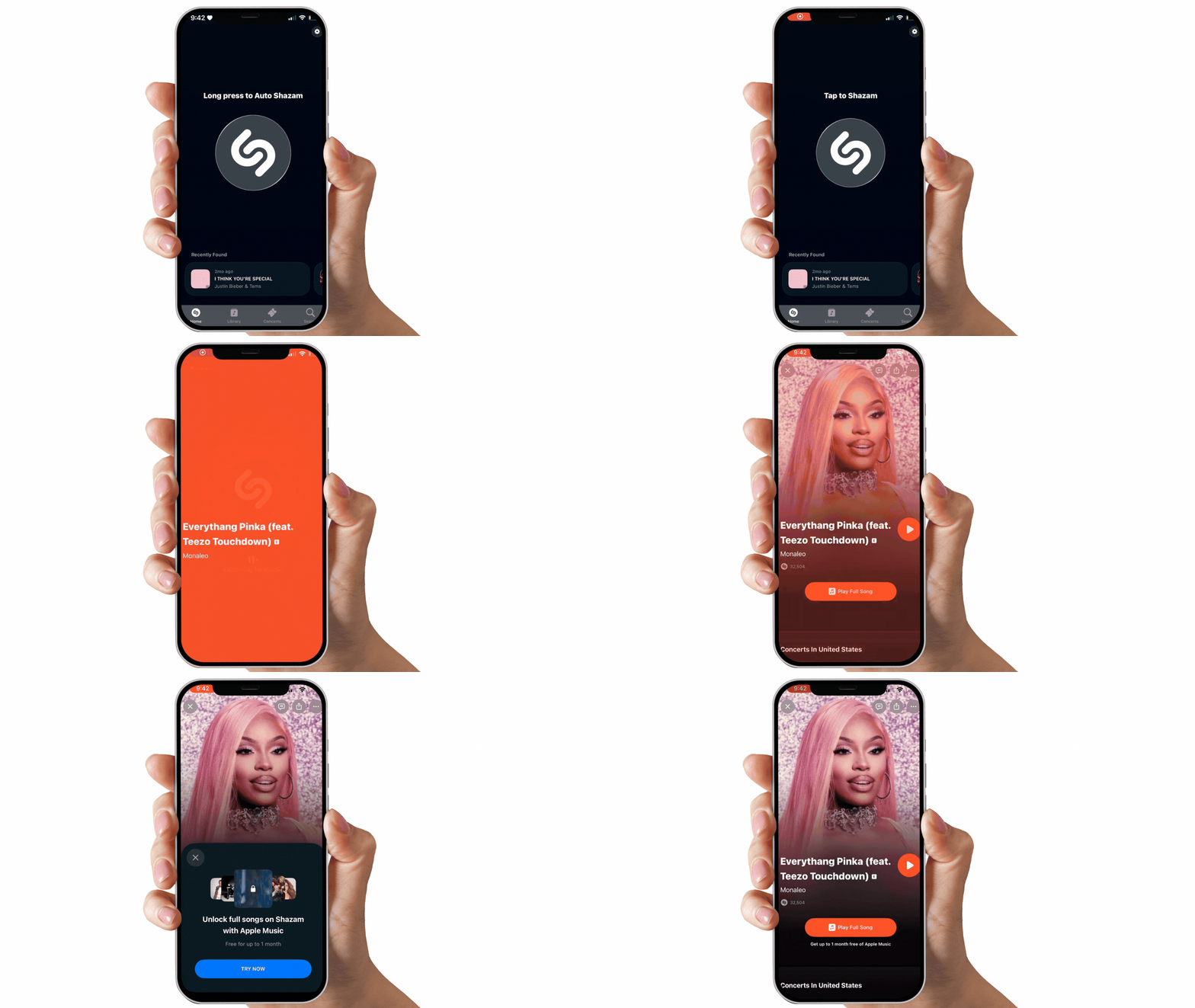
People came to Shazam with one goal:
identify a song.
Once they find it, they immediately leave the app to continue listening elsewhere.
Problem
📱 90%+ of users reported switching to another music app after identifying a song
The redesign focused on three key changes:
Discover people by surfacing profiles of users who also Shazamed the same song.
Build a personal music identity by allowing users to save songs to their own profile.
Capture the moment by attaching each song to the location where it was first discovered, creating a more meaningful connection to the music.
Solution
100% of users stayed on Shazam longer to continue exploring.
60% increase in users discovering new tracks during sessions.
Outcome
"It still feels like Shazam,
just with more reasons to stay."

Enhance, don't replace
The goal wasn't to reinvent Shazam's core functionality. Song recognition is already fast, intuitive, and trusted. Instead, we explored how the moments after identification could better support discovery, connection, and exploration.
Music discovery is social
Before proposing solutions, we wanted to understand what users actually did after identifying a song.
Primary research showed that people discover their favorite songs through friends, family, and communities.

Songs are tied to moments, not just artists
User testing showed that people don't just remember a song. They remember where they heard it or who they discovered it with.
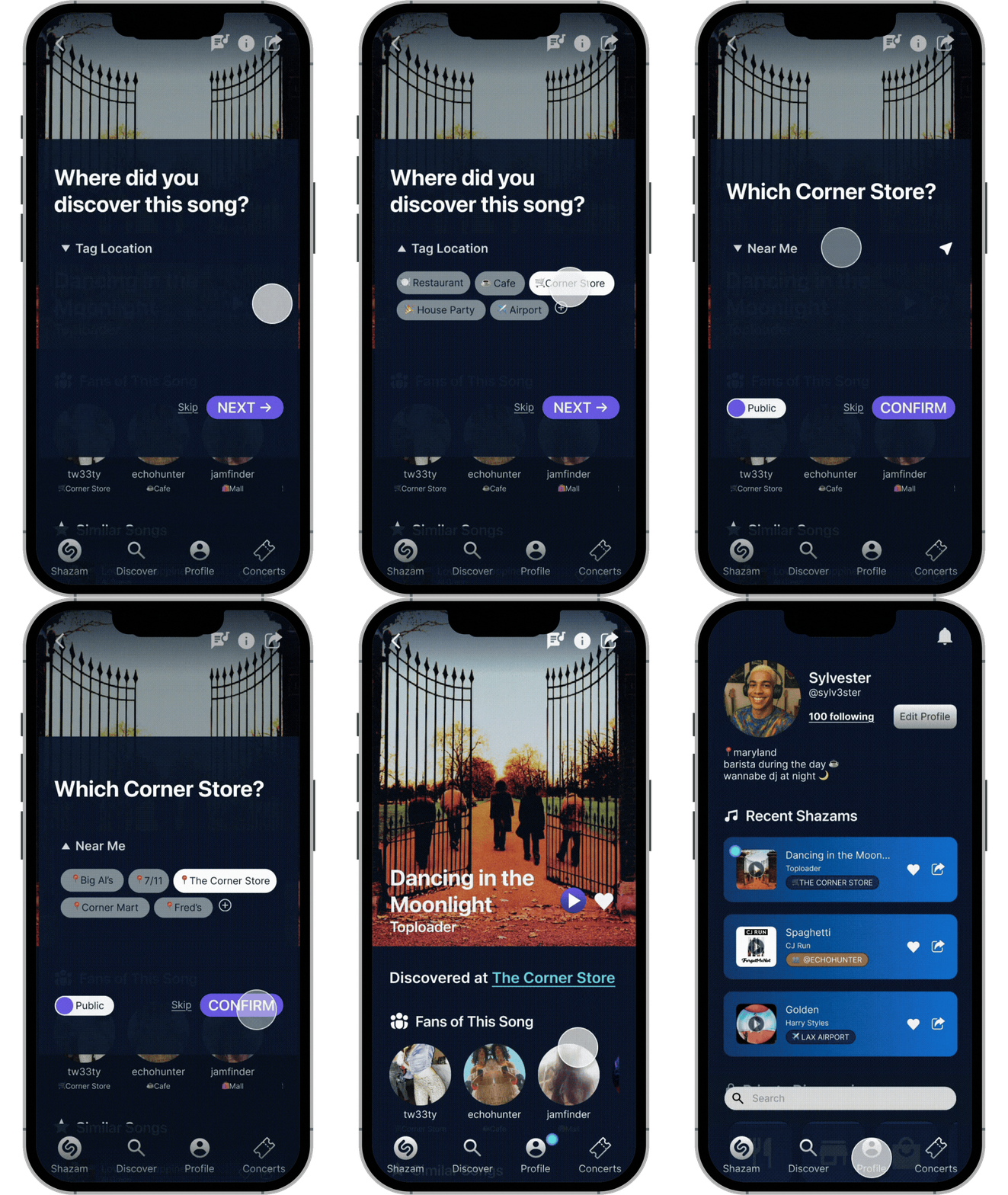
Giving the songs precise location tags
Participants naturally associated songs with the places they visited and the people they were with. We learned that people cherish their current music collections and are looking to enrich them. To preserve those moments, we allowed users to save each Shazam with the exact location where it was discovered, turning every saved song into a meaningful memory.
Refining the listening experience
Usability testing challenged many of our initial assumptions.
Rather than refining visual details, each round of testing uncovered opportunities to simplify the experience, improve discoverability, and make community-driven music discovery more intuitive.
Helping users discover music through people
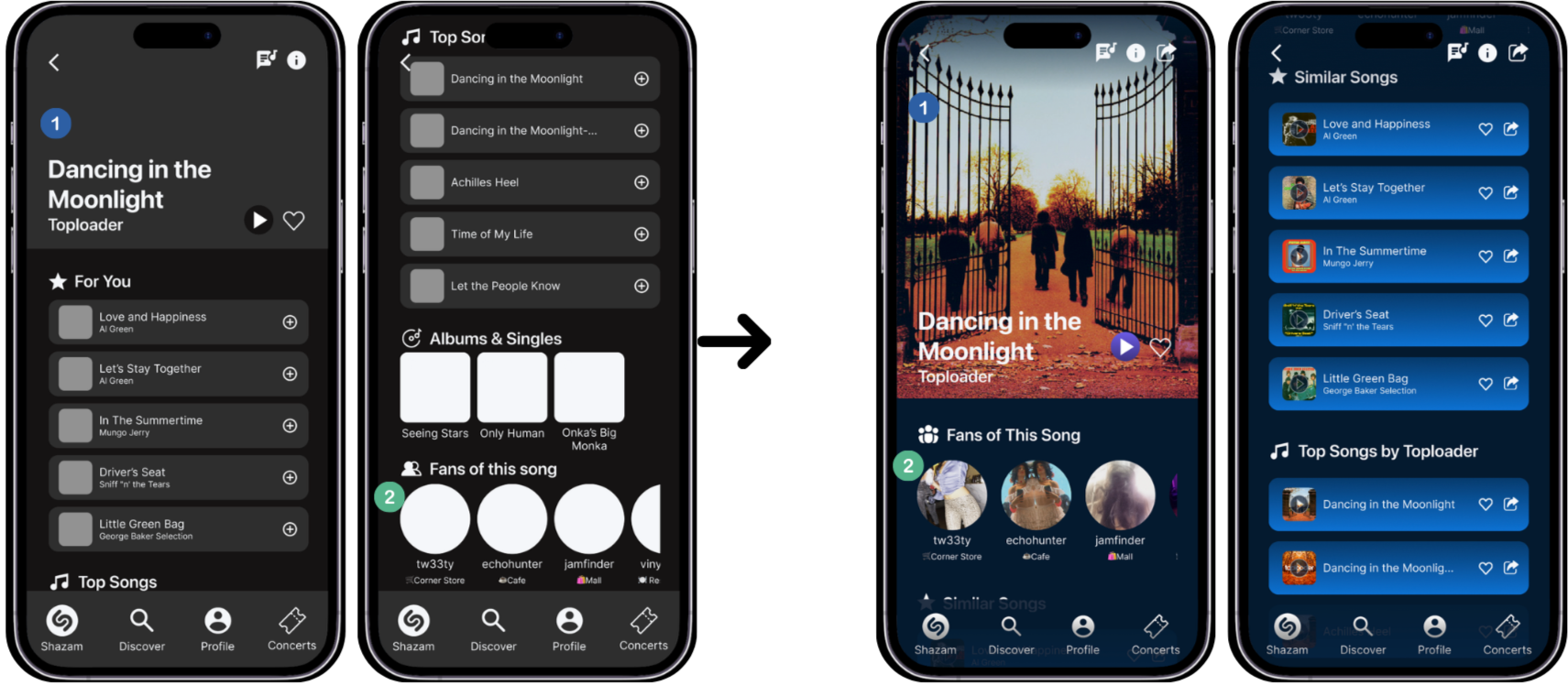
Research revealed that most participants overlooked user profiles entirely.
Rather than intentionally skipping them, they simply never encountered the feature, missing an opportunity to discover music through people with similar tastes.
What changed
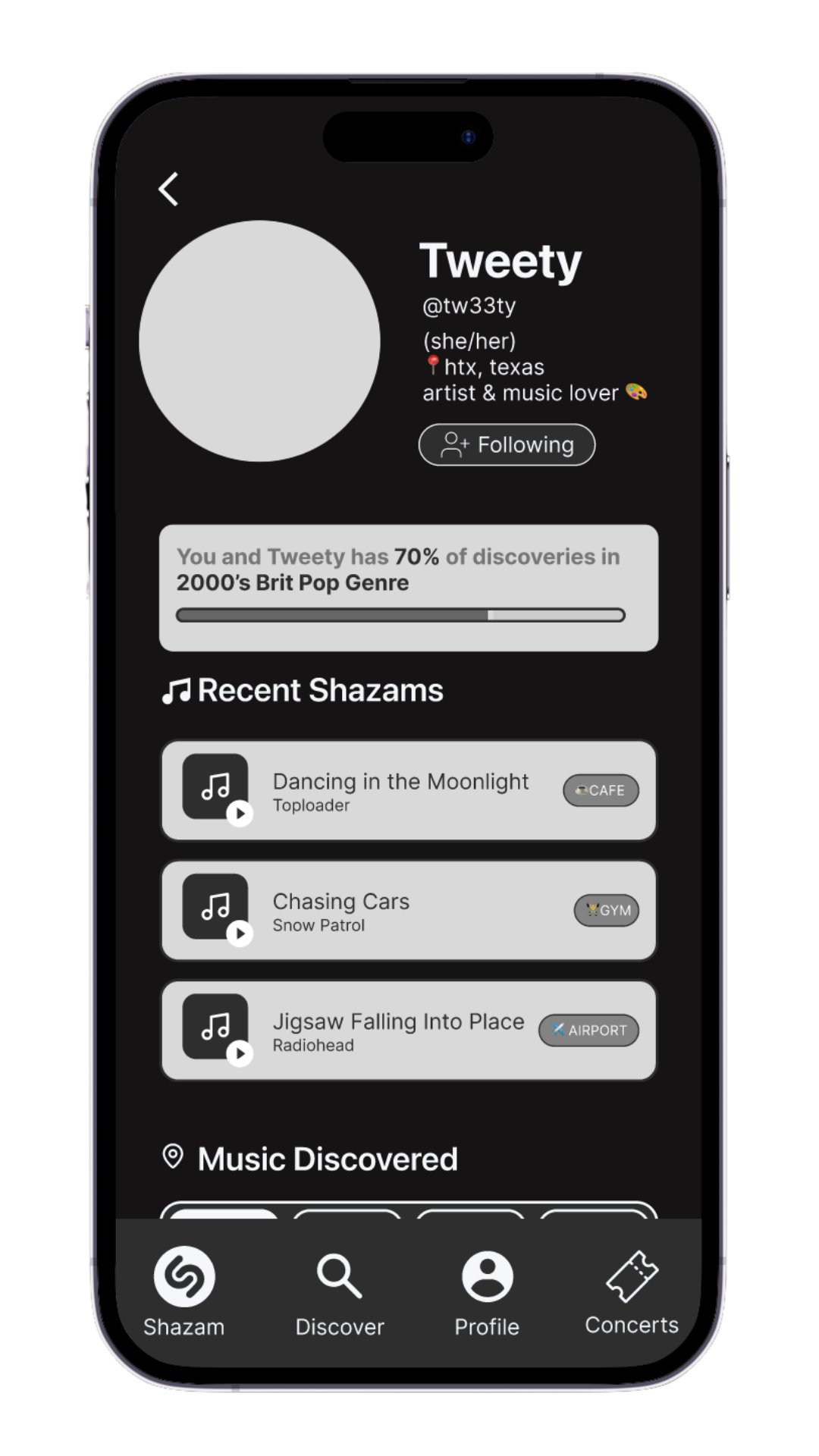
Moved user profiles higher in the hierarchy, making them visible earlier in the experience and introducing community discovery as a natural next step
Making memories easier to revisit
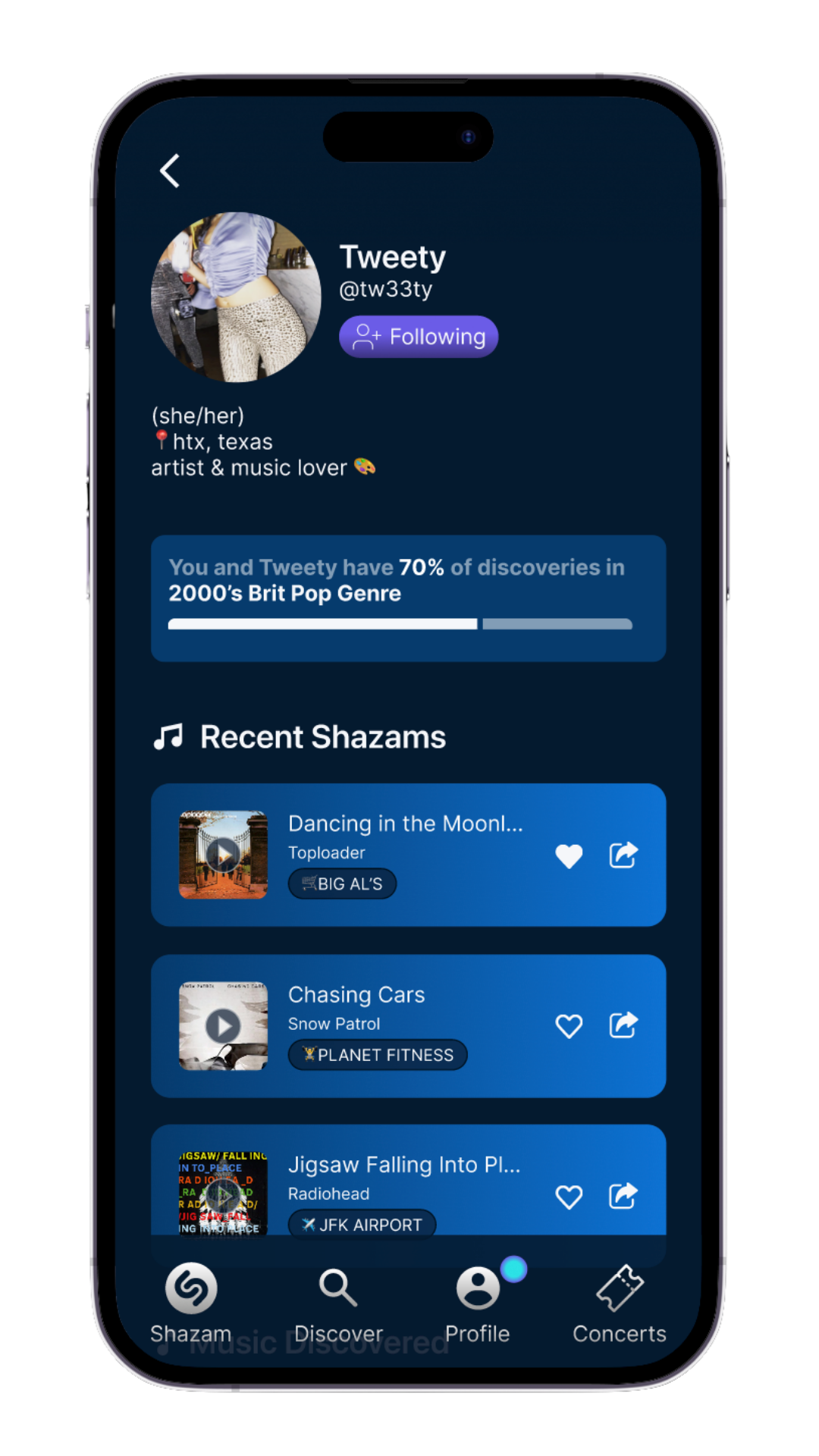
Research showed that users rarely remembered discovering a song at a generic place like "café."
Instead, they remembered the specific place.
Whether it was:
The Corner Store
Big Al's
Fred's
Those details made the memory meaningful.
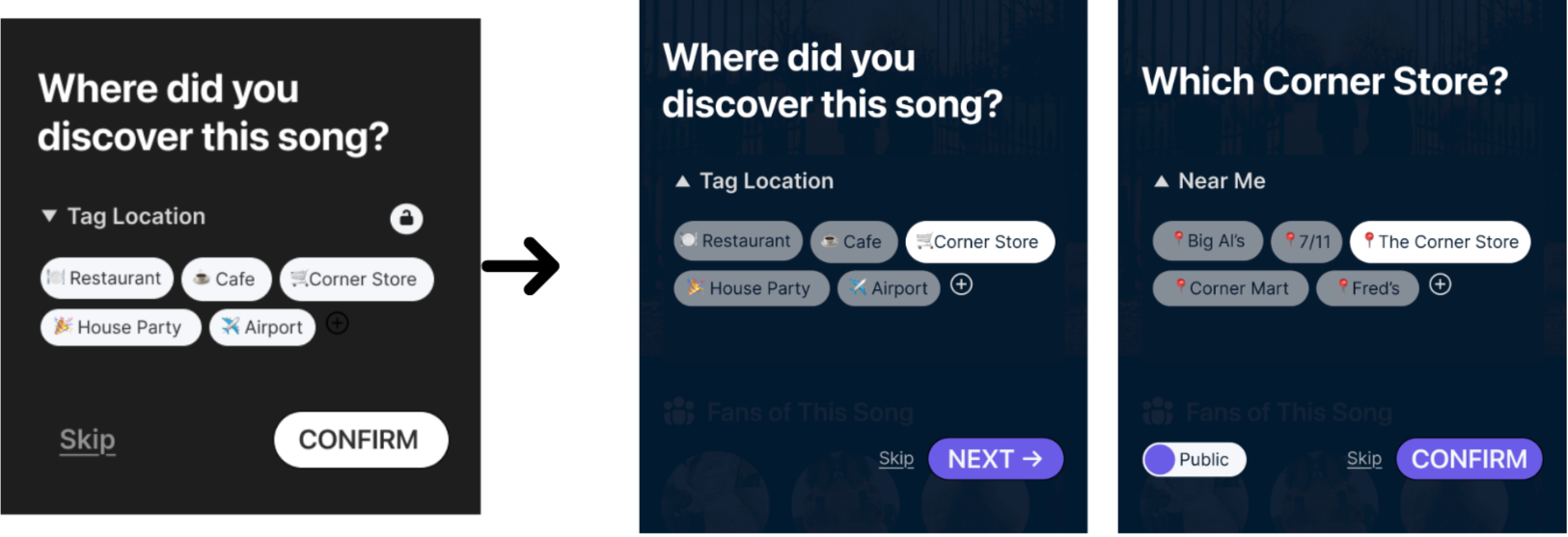
What changed
Replaced broad categories with specific nearby locations
Strong profile creation & discovery through interactions
Research showed that people rarely discover music in isolation.
Recommendations from friends, creators, and people with similar tastes felt more trustworthy than generic suggestions.
Rather than adding another recommendation feed, we designed profiles that helped listeners discover music through one another.
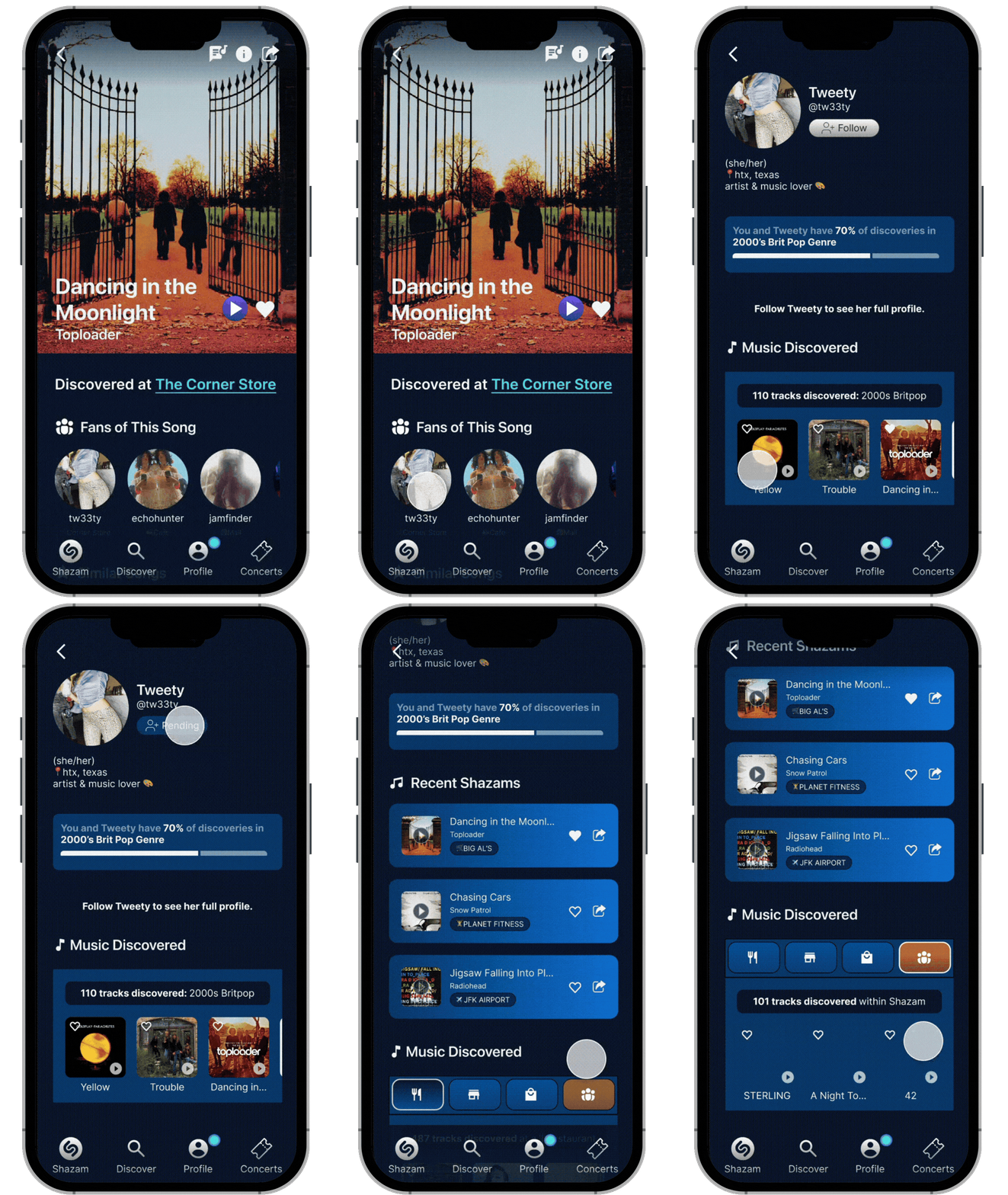
Designing profiles that invite discovery
Research revealed that users were more interested in discovering music than comparing statistics.
The profile highlighted listening data, but gave little reason to continue exploring. As a result, many participants viewed the profile, then left the experience.
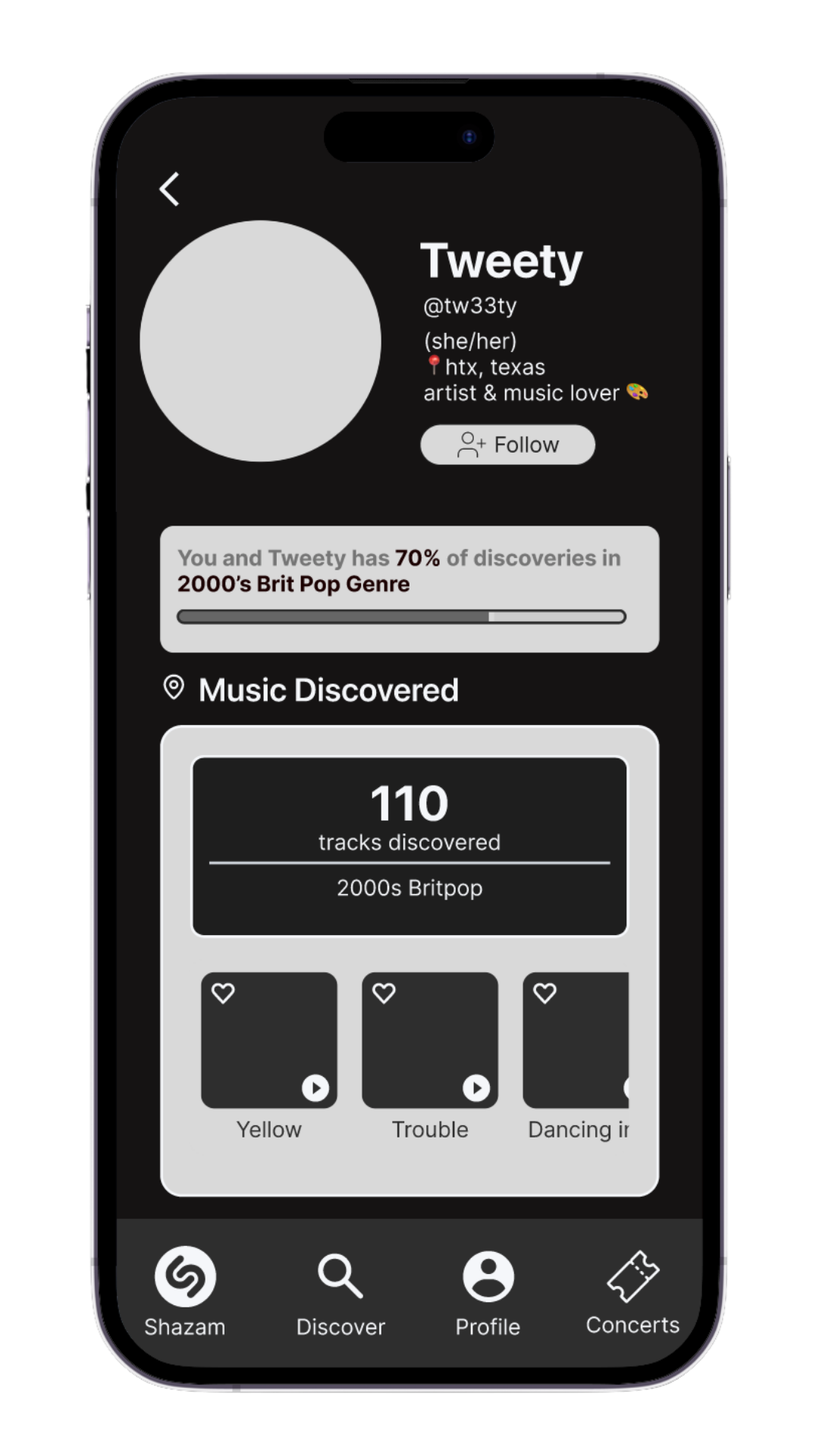
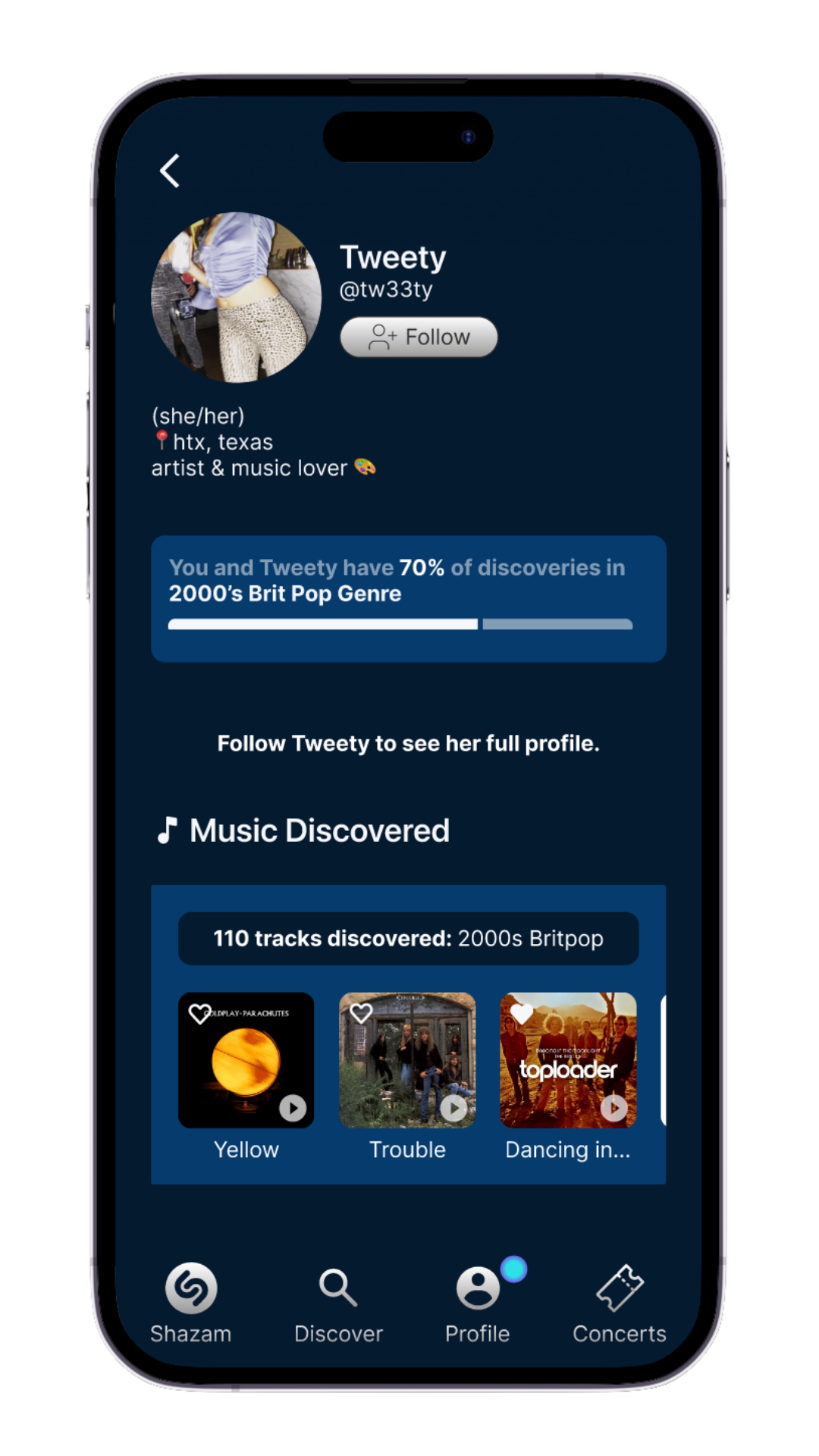
What changed
We reduced the emphasis on listening statistics
Surfaced shared music and discovery opportunities first to make it clear that following another listener unlocks more music to explore
Keeping users in the flow of discovery
Participants frequently wanted to save or share songs while browsing another person's profile.
Instead of continuing to explore, they were forced to return to the song detail page, interrupting the discovery experience.
Rather than asking users to leave what they were exploring, we brought those actions directly to each track, allowing them to stay engaged without breaking their flow.
What changed
Added Like and Share actions directly to every song.
Reduced unnecessary navigation back to the song page.
Made saving discoveries feel effortless while browsing.
Expanding where music discovery happens
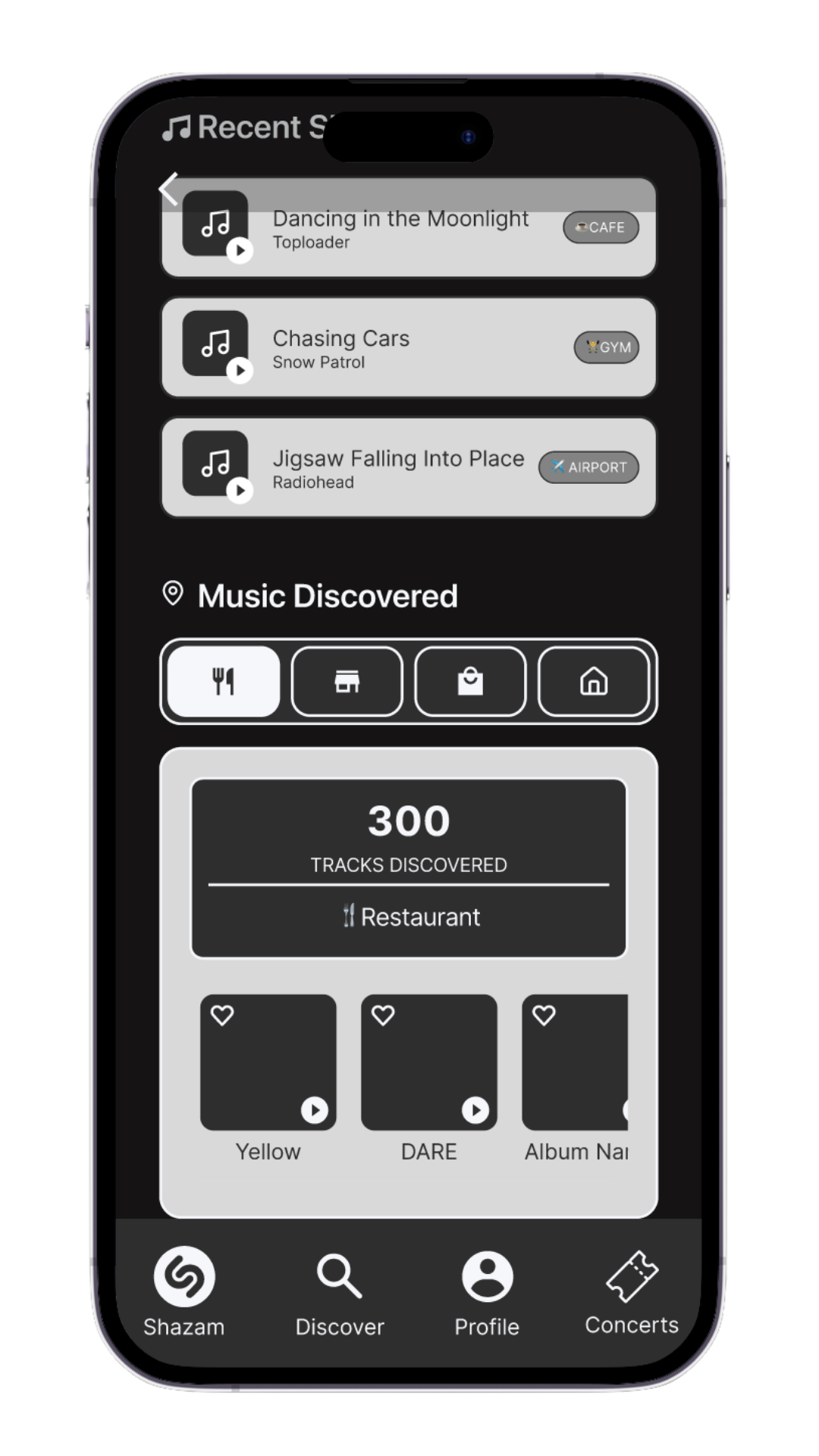
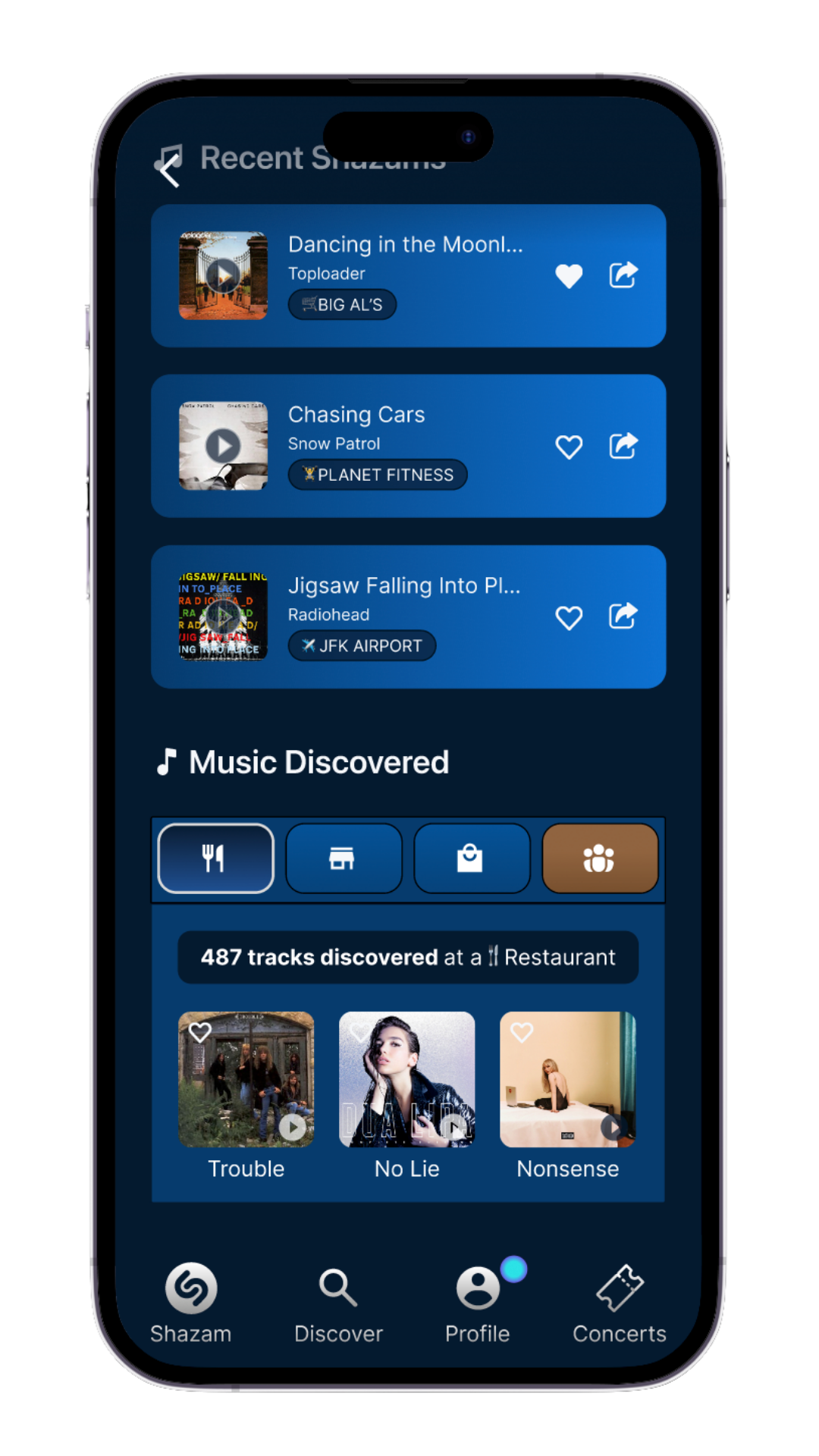
Research revealed that people don't only discover music through physical places.
Many participants described finding new songs through friends, creators, and people with similar tastes.
That insight broadened the direction of the project. Instead of relying solely on location-based discovery, we introduced community-driven discovery, creating another path for users to continue exploring after identifying a song.
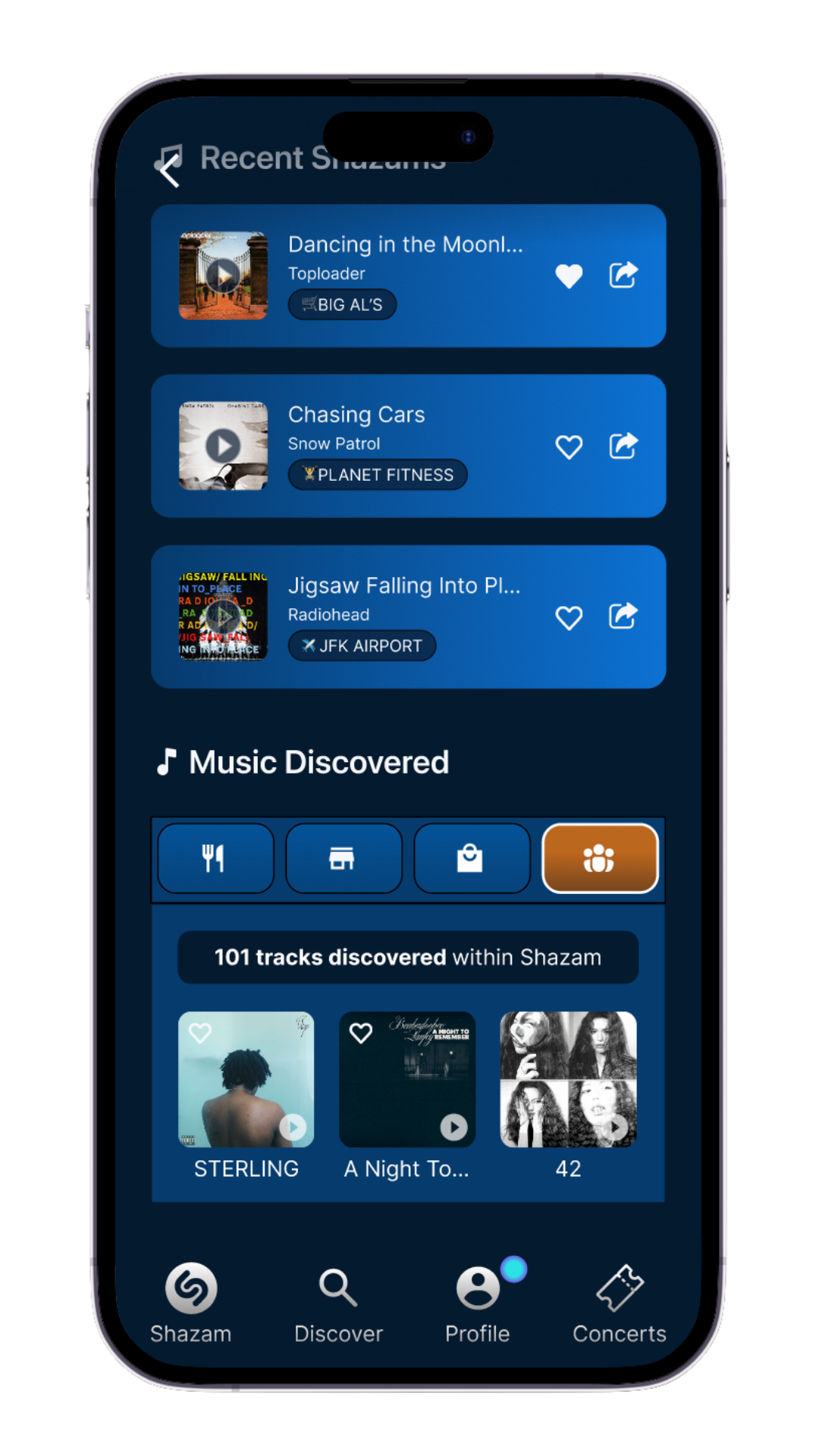
What changed
Introduced community recommendations alongside location-based discovery.
Connected listeners through shared taste instead of shared locations.
Created another path for continued exploration beyond song recognition.
Areas for Growth
These opportunities emerged from user research and usability testing but were intentionally omitted from this redesign to maintain a focused scope.
Recommend people with similar listening habits.
Personalize profile recommendations based on listening history and saved songs.
Explore richer location memories by incorporating events, concerts, and recurring places into music discovery.
What I Learned
I kept going back and reworking the social experience several times because I didn't want Shazam to become just another social app. The goal was always to support music discovery, not distract from it.
Many early ideas expanded the experience, but not all of them added meaningful value. Testing helped me focus on the ideas that made discovery feel more natural.